Tel:+86-575 -87957662
 Email:
 English
 中文简体
中文简体
The Bottom Line: A disciplined, multi‑layer maintenance program—combining precision lubrication, real‑time temperature monitoring, systematic inspections, and corrective alignment—can extend tilting pad thrust bearing life by over 100% and reduce unplanned downtime by 60–70%. These practices are not optional; they are the proven foundation for reliability in high‑speed turbomachinery and heavy‑duty industrial applications.
1. Lubrication Management – The Decisive Factor
Over 70% of premature failures originate from lubrication issues—wrong viscosity, contamination, or supply interruption. Mastering lubrication is the single highest‑impact action.
Oil Supply Strategy
- Flooded lubrication – suitable for lower‑speed applications (pumps, hydro turbines) with moderate loads.
- Directed lubrication – delivers oil directly to pad leading edges; preferred for high‑speed machinery (compressors, steam turbines) for superior thermal control and higher thrust capacity.
Oil Quality & Contamination Control
- Viscosity deviations of even one ISO grade can alter film thickness by 15–20% – always adhere to OEM specs.
- Conduct quarterly oil analysis for particle count, water content, and oxidation. Water contamination above 0.1% drastically reduces load capacity.
- Replace filters when differential pressure rises 30% above baseline, or every 6 months.
System Integrity
- Ensure supply pressure is established before shaft rotation – pressure loss at startup is a leading cause of pad wipe.
- Flush all piping and the reservoir during every major overhaul to remove accumulated sludge.
2. Temperature Monitoring – The Unmistakable Early Warning
Embedded thermocouples at the pad trailing edge can detect developing distress 200–500 operating hours before visible damage occurs. Temperature is the most actionable real‑time metric.
Sensor Placement & Interpretation
- Place sensors 1–2 mm below the babbitt surface at the trailing edge – the hottest zone.
- Monitor each pad individually. Differential temperatures of 5–8°C (9–14°F) between pads indicate uneven loading or misalignment.
Actionable Thresholds
- Normal range: 60–80°C (mineral oil); up to 100°C for synthetics.
- Warning: set alarm at 10°C below the oil’s maximum safe temperature.
- Critical shutdown: any pad exceeding 110°C (230°F) – thermal film breakdown is imminent.
What Rising Temperatures Tell You
- Uniform rise → increasing load or deteriorating oil viscosity.
- Single‑pad spike → pivot damage, debris under pad, or leveling plate wear.
- Cyclic fluctuations → axial vibration or thrust collar run‑out.
3. Systematic Inspection & Disassembly Protocol
Never clean the bearing before inspection – debris, staining, and deposits are critical diagnostic evidence. A methodical component‑by‑component examination uncovers root causes, not just symptoms.
Inspection Frequency & Focus
- Daily (per shift): temperature/vibration readings, visual oil leak check.
- Weekly: 30‑minute visual of accessible components; oil level and clarity.
- Monthly: comprehensive visual of pads, pivots, housing – look for pitting, scoring, loose fasteners.
- Annually (or at overhaul): full disassembly, dimensional checks, and pivot‑to‑pad clearance verification.
Key Inspection Points
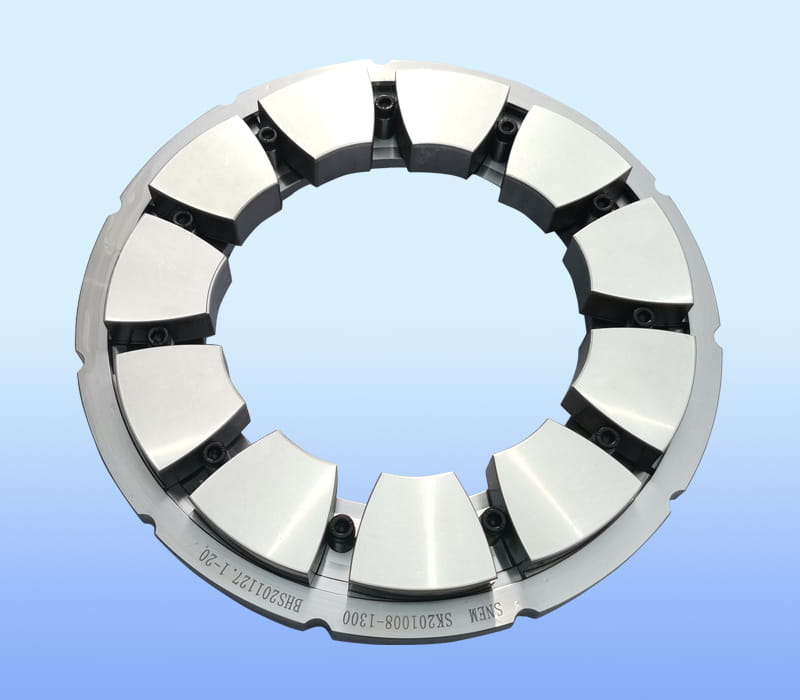
- Babbitt surface: any wiping, cracking, or embedded particles – even minor scratches can grow rapidly.
- Pivots and leveling plates: wear or brinelling here leads to uneven pad tilt and load concentration.
- Thrust collar: check for run‑out, scoring, or thermal distortion.
4. Alignment & Leveling – Precision That Pays
Misalignment is responsible for up to 30% of thrust bearing failures. Even slight angular or axial misalignment multiplies pad loading and accelerates fatigue.
Critical Alignment Checks
- Radial alignment between rotor and bearing housing – use dial indicators to ensure run‑out within 0.05 mm (0.002 in).
- Axial squareness of the thrust collar relative to the shaft axis – collar face run‑out must be below 0.025 mm (0.001 in).
- Leveling plate flatness – check with a precision straightedge; any convexity or concavity alters pad pivot geometry.
When to Correct
- If any pad shows uneven wear (more than 30% difference in thickness across pads), realign the entire train.
- After any coupling replacement or major shaft work, perform a full alignment verification.
5. Advanced Condition Monitoring – Beyond Temperature
While temperature is primary, supplementary techniques provide deeper insight. Combining vibration analysis, oil debris monitoring, and shaft position sensors creates a comprehensive health picture.
Recommended Monitoring Suite
- Vibration (axial and radial) – sudden increases in axial vibration often precede pad damage by 50–100 hours.
- Oil debris (ferrography or particle counters) – rising ferrous particle concentration indicates wear progression.
- Proximity probes to monitor shaft axial position – a drift of 0.1 mm can change pad loading by 10–15%.
6. Consolidated Maintenance Schedule – At a Glance
| Frequency | Primary Actions | Key Metrics / Targets |
| Daily | Temperature/vibration log; visual oil leak check | T < 80°C; vibration stable |
| Weekly | Inspect oil level, clarity, and filter condition | Oil clear, no foam; pressure stable |
| Monthly | Visual pad/pivot inspection (without disassembly) | No scoring, pitting, or loose parts |
| Quarterly | Oil analysis (viscosity, water, particle count) | Water < 0.1%; ISO cleanliness ≤ 16/14/12 |
| Annually / Overhaul | Full disassembly, dimensional checks, pivot wear measurement | Clearances within 90% of new spec |
7. Decision Flowchart – When to Act
8. Final Takeaway – Integrated Maintenance Wins
No single practice guarantees bearing longevity. The synergy of clean, correct‑viscosity oil, strict temperature vigilance, scheduled inspections, precise alignment, and complementary condition monitoring creates a robust defense against premature failure. Implementing all these elements consistently can push bearing life beyond 15 years in many rotating machines, with mean time between overhauls increasing by 40–60%. Start with a written maintenance schedule, train your team in each procedure, and treat every deviation as a learning opportunity – that is the path to maximum return on your thrust bearing investment.