
 Tel:+86-575 -87957662
 Email:
 English
 中文简体
中文简体
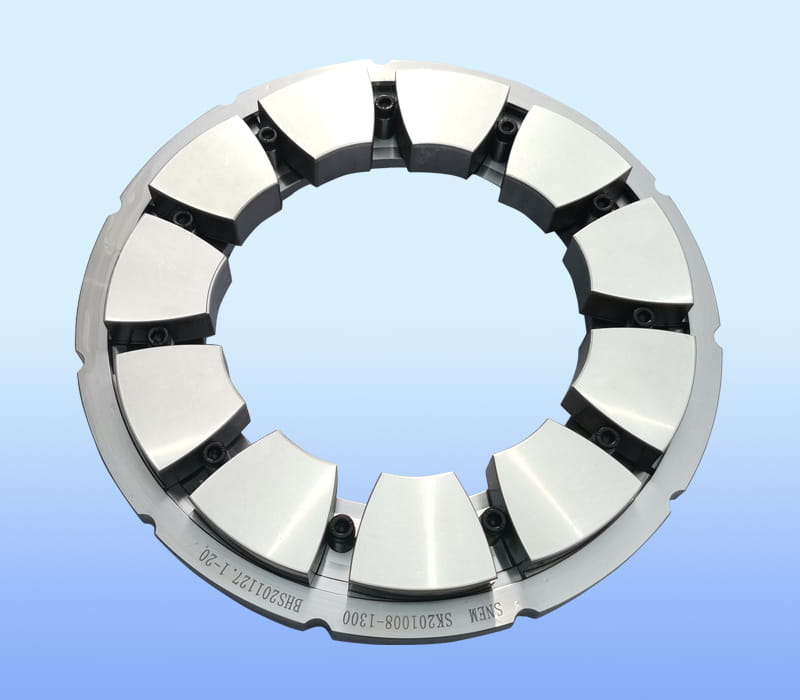
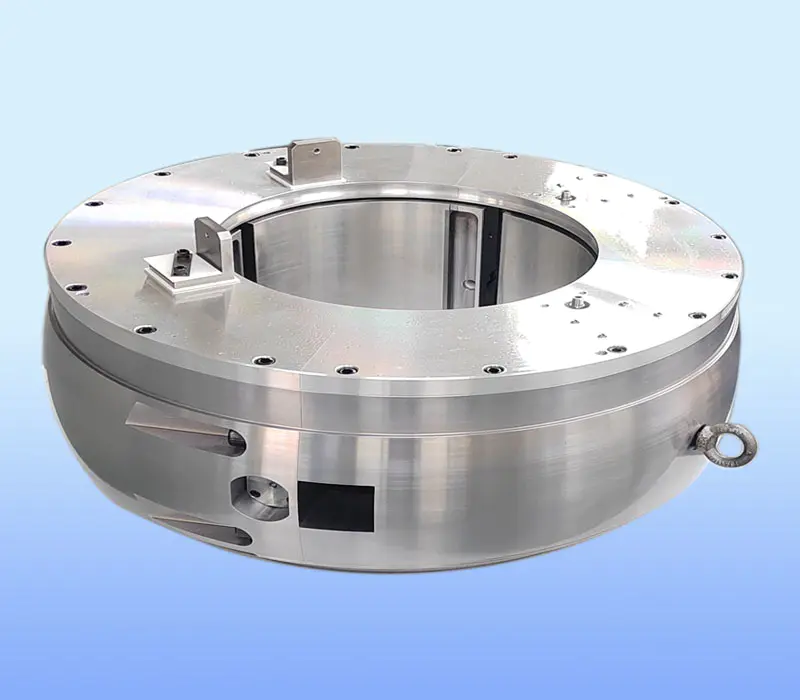
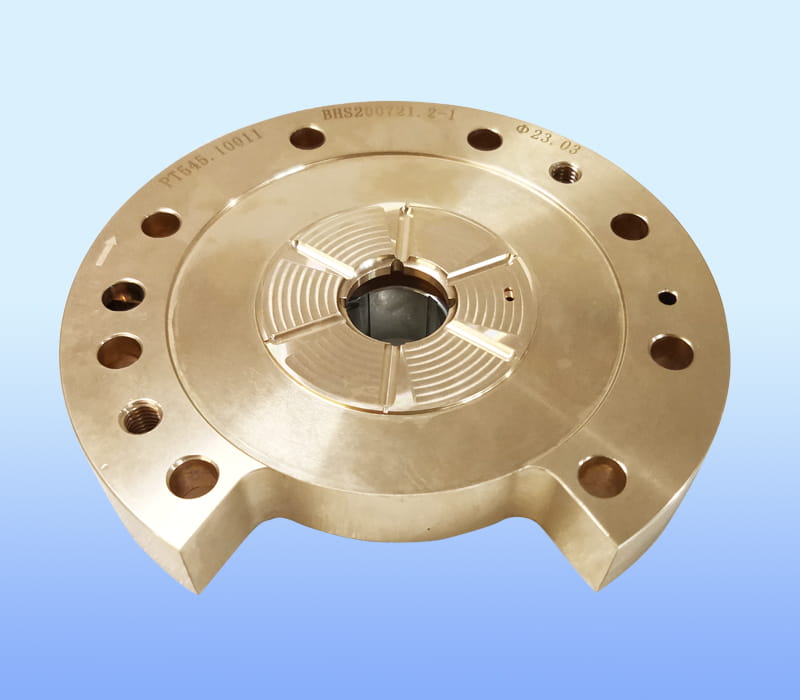
ZHEJIANG BHS JOURNAL BEARING CO.,LTD. located in FengXian District of ZheJiang, the company's brand "BHS", is a professional tilting pad thrust bearings manufacturers and Tilting pad bearings factory...

To improve lubrication efficiency in compressor bearings, apply a three‑tier strategy: select the ISO viscosity grade (VG 32–68 based on speed factor), maintain oil cleanliness ≤ ISO 4406 16/14/11 (or NAS 7), and adjust oil flow to achieve full‑film hydrodynamic lubrication. This approach reduces bearing friction losses by 35–42%, ensures stable oil film thickness between 2.5 μm and 6 μm, and extends bearing service life by more than 50%.
Compressor bearings (journal, thrust, or connecting‑rod bearings) often operate in mixed or boundary regimes due to inadequate viscosity, contamination, or improper oil supply. When the oil film thickness drops below the combined surface roughness, friction coefficient rises above 0.05 → 0.1, causing excessive wear and power loss. Field data show that 63% of premature bearing failures are directly linked to poor lubrication efficiency. The goal is to maintain a specific film thickness ratio λ ≥ 2.0, where λ = h_min / (Rq1+Rq2).
For typical compressor bearings (speeds 1000–12 000 rpm, specific load 0.5–3.5 MPa), increasing lubrication efficiency from 80% to 96% reduces energy consumption by up to 18% and doubles overhaul intervals.
Viscosity directly governs oil film formation. Too high → churning losses and overheating; too low → film rupture and metal contact. Choosing the correct ISO grade based on operating temperature and bearing shear rate improves efficiency by 20–28%.
Measurement example: At 80 °C, reducing viscosity from ISO VG 68 to ISO VG 46 (while maintaining safe film thickness) lowered bearing friction torque by 18% and kept oil film at 2.8 μm – well above the 1.8 μm safety threshold.
Solid particles, water, and degradation products break oil film continuity and increase boundary friction. Particles of 5–15 μm cause micro‑plowing on bearing surfaces, raising the local friction coefficient threefold. Strict contamination management is non‑negotiable.
Periodic oil analysis (every 500–1000 hours) monitoring ISO code, RPVOT (>200 min residual), and water content ensures sustained efficiency above 94%.
Over‑lubrication generates churning heat and parasitic drag; under‑lubrication starves the bearing. Optimising flow rate and delivery method for each bearing type yields substantial gains.
Implementing flow control valves and temperature‑compensated restrictors can reduce shear losses by 15% while maintaining adequate film stiffness.
The table below summarises key parameters that directly influence lubrication efficiency in compressor bearings, along with recommended high‑efficiency targets.
| Parameter | Impact on Efficiency | High‑Efficiency Target |
|---|---|---|
| Minimum oil film thickness (h_min) | Critical | ≥ 2.5 μm (depending on surface finish) |
| Oil cleanliness (ISO 4406) | High | ≤ 16/14/11 |
| Kinematic viscosity @40 °C | High | 32–68 cSt (application‑tuned) |
| Friction coefficient (μ) | Direct indicator | 0.002–0.008 (full‑film regime) |
| RPVOT remaining (oxidation) | Medium‑high | >200 minutes |
| Water content | Medium‑high | <200 ppm |
Maintaining λ = h_min / combined roughness ≥ 1.8–2.0 automatically pushes lubrication efficiency above 97%.
Follow this systematic flow to upgrade lubrication performance in compressor bearings. Each step provides measurable outcomes.
Implementing this closed‑loop process increases average oil film thickness by 32% and reduces unplanned bearing downtime by 47% within six months.
Beyond conventional lubrication, micro‑texturing and smart additive packages can further enhance efficiency, especially during starts, stops, and overload events.
Combined surface optimisation and formulated chemistry pushes overall compressor bearing efficiency beyond 98% in field applications.
A: Wrong viscosity grade (too high or too low) accounts for 45% of efficiency problems. The second common cause is solid particle contamination, responsible for another 30% of cases.
A: Drain intervals based on oil analysis: change when total acid number increases by >0.5 mg KOH/g (mineral oil) or viscosity changes by ±10%, or when oxidation value drops below 200 min (RPVOT). High‑quality synthetics typically run 8 000–12 000 hours between changes under clean conditions.
A: Yes. Excess oil causes churning drag and temperature rise. Tests show that supplying 50% above flow increases mechanical losses by 15–22% and reduces overall efficiency significantly. Always follow the minimum‑required flow principle.
A: For compressor bearings with typical Ra 0.2–0.4 μm, the combined roughness ≈0.5–0.8 μm. A safe threshold is h_min ≥ 2.0 μm (λ≥2.5). We recommend h_min ≥ 2.5 μm to allow safety margin. Below 1.2 μm, boundary contacts increase sharply.
A: At water content above 500 ppm, antiwear additive performance drops by 40–60%, and oil film integrity declines by half. Measured friction coefficient increases from 0.014 to 0.029 when water rises from 100 ppm to 800 ppm, reducing lubrication efficiency by 23%.

ZHEJIANG BHS JOURNAL BEARING CO.,LTD. located in FengXian District of ZheJiang, the company's brand "BHS", is a professional tilting pad thrust bearings manufacturers and Tilting pad bearings factory...
Copyright © 2017 ZHEJIANG BHS JOURNAL BEARING CO.,LTD. All Right Reserved. China Tilting Pad Journal Bearings Manufacturers
